
'The people of Bangladesh have voted for a party that represents political interest.'
'It is a pro-Liberation party and it believes in the spirit of 1971, as opposed to the Jamaat-e-Islami, which was opposed to the Liberation struggle of Bangladesh in 1971.'

'If you fire two missiles at Jamnagar or ten missiles there, what do you think India will do?' 'India will fire 500 missiles on Tarbela and Mangla, destroy the Sukkur Barrage, destroy Karachi port.' 'When you start issuing threats, it should be with some sense and sensibility.' 'You shouldn't just shoot your mouth off just because you have appointed yourself field marshal.'

'India for its survival has to change its doctrine from no first use to a pre-emptive attack in case of any hostile move by Pakistan,' recommends Colonel Anil A Athale (retd).
'Pakistan is economically very weak and will not be able to sustain a war for long.'

The editorial termed the decline in Sikhs and Buddhists numbers in religious data of Census as "worrisome" and said whenever indigenous faiths have declined separatist tendencies increase and called for concrete policy measures to correct it.
Former National Security Advisor (NSA) Shivshankar Menon has stated that the political dynamics between India and Pakistan have resulted in a "controlled level of hostility" that benefits the ruling elites in both nations. Speaking at the Kerala Literature Festival, Menon described Pakistan as a "brand new state" still grappling with its national identity. He argued that India's foreign policy towards Pakistan is influenced by its domestic politics, resulting in an uneasy equilibrium characterized by a "controlled level of hostility." Menon also questioned the concept of a multipolar world, stating that the current global order is merely "confused." He emphasized that the United States remains the world's true military hegemon, while other nations, including China, are regional powers. Menon further argued that there is no binding international order, leading to a state of "between orders." He highlighted the absence of definitive international agreements on crucial issues in recent decades.
'If Pakistan's army wants to escalate violence in Kashmir, they have an unlimited supply of jihadis they can train and send. That's not an issue for them.'

"The way the hijab imbroglio unfolded gives scope for the argument that some 'unseen hands' are at work to engineer social unrest and disharmony. Much is not necessary to specify," the three-judge bench headed by Chief Justice Ritu Raj Awasthi said in the order.

Pakistan wanted to be constitutionally communal, India wanted to be secular but is communalising itself. All three nations share a penal code, but they have amended their laws to enable the State to specifically target minorities, points out Aakar Patel.

In the letter to the Bihar CM, the Bharatiya Janata Party MP and rural development minister said, 'Things which have no connection with Islam are being Islamised. Some institutions have become self-proclaimed in giving halal certificate and are giving halal certificate to companies manufacturing goods by paying huge sums of money.'

'Imran Khan's rule was dismal. Despite this, he has become a cult figure.' 'He sold the dream of a Naya Pakistan to the people of Pakistan, especially the youth, and branded all other politicians as corrupt.' 'Hence, his popularity.'

Pakistan still has to acquire the patience you need in a democracy. The patience to accept that even if I do not like the government I have, I must wait till the next election to change it, explains Shekhar Gupta.

'If there were completely free elections tomorrow, the mullahs will not be in majority rule,' says novelist Kamila Shamsie.
Stratfor says there exists a strong nexus between ISI and Bangladesh's intelligence agencies.
India is too diverse to be governed centrally and with a single system. The way forward is for the central government to keep the monopoly of military power and a share of national resources while the provinces must have greater autonomy, recommends Colonel Anil A Athale (retd).

'The last thing he would want is new tensions with India.'

'It is not just the religious minorities who are being intimidated or targeted.' 'You see an equal intimidation or effort of intimidation towards anyone who does not agree with the Hindutva interpretation of the Hindu faith.'
The concept of 'fairness by rulers' is deeply ingrained in Indians and any weakening of this dents the legitimacy of the ruler, warns military historian Colonel Anil A Athale (retd).

'A stable and strong Pakistan with an anti-India mindset and hatred is not good for us.'

The modern world will not accommodate bigotry of the sort India is showing the world today, argues Aakar Patel.

Zia confessed his admiration for Mangeshkar while talking with late Indian journalist Kuldip Nayar in 1982.

India has much paranoia in India about a new 'Terroristan' coming up between Pakistan and a Taliban-ruled Afghanistan. Pakistan has zero ability economically, diplomatically, geostrategically or militarily to create one. If they try, it will be great for India as they will destroy themselves yet again, asserts Shekhar Gupta.
'Therefore, these people want Imran Khan out of the elections whenever it is held.' 'For this, he will have to be disqualified from contesting on the basis of cases against him, declaring that he is not sadiq (honest) and ameen (righteous).'

'In a war of guerrilla resistance from 1682 to 1707, the Marathas destroyed the foundations of the Mughal empire.' 'Shivaji was dead, but his example and ideals survived and were the main source for inspiration for the Marathas in their desperate struggle with the mighty Mughal empire,' notes Colonel Anil A Athale (retd), the well known military historian.
'Aurangzeb, who had destroyed the Hindu temples of Mathura and Kashi and many others in the north, was a very different ruler when he came to Maharashtra.' 'He did not touch a single temple in Maharashtra.' 'It was possibly the greatest triumph of Shivaji's statesmanship,' notes Colonel Anil A Athale (retd), the well known military historian.
'We have Hindu values, Hindu customs, Hindu philosophy, Hindu way of looking at all religions as acceptable.' 'These are all great assets of India.'
Pakistan would want to take full advantage of the situation to direct Taliban trained terrorists into the Kashmir Valley, alert Lieutenant General Ashok Joshi (retd) and Colonel Anil A Athale (retd).

Given our troubled relationship with Pakistan, we need to keep our security apparatus in a state of alert with state-of-the-art equipment. All bilateral issues with Pakistan -- political, military, economic -- will simply have to go on the back-burner till Pakistan decides it wants to live as a good neighbour, says Vikram Sood.

Presenting the best street foods across the world.
Today, hour-long, high-pitched 'debates' at prime time, replete with inflammatory visuals and captions, using half-truths, insinuations and lies, pour venom against Muslims and seek to divide Hindus and Muslims, notes Jyoti Punwani.
'China is likely to help Pakistan in keeping the fire burning in J&K to bleed India for its own interests.' A fascinating excerpt from Lieutenant General K Himalay Singh's Making of a General: A Himalayan Echo.
'Between now and 2021, Bengal's politics could change irrevocably,' predicts Kanchan Gupta, Distinguished Fellow, Observer Research Foundation.
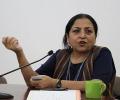
Madhu Kishwar is a patriot whose freedom of expression needs to be supported by all, especially the liberals, says Sankrant Sanu.

Purists may balk at this level of public discourse, but no one can deny its ability to marshal opinion.
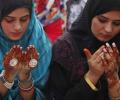
'The osmosis between Hinduism and Islam that really gave birth to the Hindustani or Indo-Islamic civilisation was due to the conversation between Muslim mystics and yogis.'

The Battle of Pratapgad can be termed the turning point in Indian history as it interrupted the continuous chain of Muslim successes on the battlefield.

'Non-violence can be a viable tool for countering the competitive brutality of terrorist groups,' argues Rajni Bakshi.
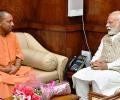
'The top-most functionaries and destiny-makers of the nation have thrown away the pretensions of statesmanship.' 'They seem to have made a categorical announcement that the next general election will be fought on the solo plank of Hindutva, rather than on good governance, economic development, and employment to youth', says Mohammad Sajjad.

'If you take pride only in being a nation with nuclear weapons and a strong military, then you think very differently from those nations that take pride in having wonderful universities and academic institutions.'

The Modi-Shah definition of secularism is, India is a confident, resurgent Hindu, and therefore secular, country.
